


Your sales pipeline is the roadmap from first contact to signed deal. Learn how car salespeople use pipeline tracking to close more vehicles and grow income.
Your sales pipeline is literally the path every customer takes from the moment they walk into the showroom (or click your text) all the way to signing paperwork. It's not some abstract thing that only dealership managers care about—it's your personal roadmap to closing more deals and actually knowing what's coming next in your day, your week, and your month.
Think of it this way: without a sales pipeline, you're flying blind. You don't know if you have 5 real opportunities or 50 tire kickers. You can't tell if customers are stalling or if you're just waiting for them to make a move. And that's where most struggling salespeople stay stuck—hoping things work out instead of building something that works predictably.
A solid sales pipeline gives you visibility into where every customer stands. That means you know exactly who to follow up with, what vehicle fits them best, and when to take action. It transforms a random collection of conversations into an organized system that actually generates income. virtual sales manager for automotive reps is built around this exact concept: tracking your deals so you can see what's working and what's not.
In this article
- What Is a Sales Pipeline in Automotive?
- Why Your Personal Sales Pipeline Actually Matters
- The Three-Stage Pipeline Model for Car Salespeople
- How to Actually Build Your Personal Sales Pipeline
- Using Your Pipeline to Fix Your Close Rate
- Pipeline Habits That Actually Stick
- The Referral Play (And Why It Matters to Your Pipeline)
- Common Pipeline Mistakes (And How to Avoid Them)
- Tools That Support Your Pipeline (Including AutomanageVM)
- Referrals, Repeat Customers, and Long-Term Pipeline Health
What Is a Sales Pipeline in Automotive?
A sales pipeline visualizes where each of your prospects stands in the buying journey. It's a visual representation of all your open opportunities, organized by stage—from first conversation to final paperwork.
In automotive sales, your pipeline typically looks like this:
- Initial Contact: Customer walked in or you reached out. First conversation happened.
- Qualification: You've talked through what they're looking for and why they're shopping now.
- Demo: They've driven a vehicle (or you're setting that up).
- Negotiation: Price and terms are being discussed.
- Close: They're ready to sign or waiting on financing approval.
- Closed Won: Deal is done. Vehicle is theirs.
The idea is simple: every customer exists somewhere in those stages. Your job is to know where, and to move them forward deliberately. That's it. That's the entire concept.
Most salespeople skip this. They rely on memory, sticky notes, or random text chains. Then they wonder why they miss follow-ups, lose deals to competitors, or have dead air between sales. No visibility = no momentum = no income growth.
Why Your Personal Sales Pipeline Actually Matters
Here's what happens when you have a real pipeline: you stop guessing about your future.
Right now, you probably can't answer these questions quickly:
- How many real opportunities do you have right now?
- Which ones are closest to buying?
- Who haven't you followed up with in 3 days?
- What's your demo-to-write-up ratio looking like this month?
- How many customers are stuck waiting for financing?
If you can't answer those without thinking hard, your pipeline is broken. And if you can't fix what you don't know is broken, you'll keep making the same mistakes.
A pipeline gives you visibility. Visibility gives you control. Control turns your sales job into a predictable income stream instead of a daily panic.
When you track where customers actually are, you can:
- Spot bottlenecks (too many people stuck in negotiation? Find out why).
- Follow up at the right time with the right next step.
- Stop chasing deals you don't really have.
- Prioritize your time on the warmest leads.
- See your demo rate and closing percentage, which is how you actually measure growth.
This isn't about being pushy. It's about being organized. Customers respect a salesperson who knows what they're doing and remembers details. That's what a pipeline gives you.
The Three-Stage Pipeline Model for Car Salespeople
You don't need to over-complicate this. Here's a framework that works for individual salespeople:
Stage 1: Prospect (Initial Contact to Demo)
Someone new is in your pipeline. You've had a conversation, gathered basic information, and you're working toward getting them in a vehicle. The goal here is to understand what they're actually looking for—not to pre-qualify them based on budget or whether you think they'll buy. Focus on vehicle selection and getting them excited about the right car.
Stage 2: Active (Demo Through Write-Up)
They've driven a vehicle or you're actively showing them options. They're engaged. Your job is to keep momentum, answer questions honestly, and help them see themselves in the right vehicle. This is where most deals either accelerate or die.
Stage 3: Pending (Negotiation to Deal Closure)
Numbers are being discussed, paperwork is moving, or financing is being worked. They're close. Your only job here is to be available, responsive, and make the process smooth.
That's it. Three stages. Every customer lives somewhere in those three buckets. Track them. Update them daily. Move them forward.
How to Actually Build Your Personal Sales Pipeline
Start simple. You don't need fancy software right away (though tools like AutomanageVM help you track this consistently). You can start with a spreadsheet or even a notebook. The format doesn't matter yet. Building the habit matters.
Try our Live Demo
Click Here →Here's what you need to track for each customer:
- Name and contact info
- When you first talked to them
- What vehicle(s) they're interested in
- Current stage (prospect, active, pending)
- Last contact date
- Next action you need to take
- Expected close date (best guess)
Update it every single day. End of shift, take 5 minutes and log where each customer actually stands. Did they drive today? Move them to Active. Are they waiting on financing? They're in Pending. This is your sales habit.
After a week, you'll start seeing patterns. You'll notice which customers are stalling. You'll catch people you forgot to follow up with. You'll see how many demos you're actually running per week, which tells you whether you need to improve your discovery conversations.
That's the power of the pipeline: data beats hope every time.
Using Your Pipeline to Fix Your Close Rate
Here's where it gets real. Your sales pipeline isn't just a tracking tool—it's a diagnostic tool.
Let's say you're closing 20% of your deals. That number came from somewhere. You took 10 customers into a demo, and 2 of them bought. Why only 2?
If you track your pipeline, you can answer that question:
- Are you not setting up enough demos? (Your prospect stage is weak.)
- Are customers going on demos but ghosting after? (Your active stage needs work—better follow-up or vehicle selection.)
- Are customers ready to buy but the paperwork process is slow? (Your pending stage has a bottleneck.)
Without this visibility, you're just guessing. With it, you can fix the actual problem instead of working harder on the wrong thing.
Let's say you're doing 10 demos a week but only closing 2. That's a 20% close rate. If you could improve that to 30% (just 3 closes from 10 demos), you'd increase your income by 50% without doing more work. That's the power of pipeline management.
This is where car sales performance tracking software changes the game for individual salespeople. You can see your metrics in real time, spot exactly where you're losing deals, and get coaching on how to improve at that stage. You're not waiting for a manager to tell you what's broken. You already know.
Pipeline Habits That Actually Stick
Tracking your pipeline only works if you actually do it. Here are the habits that make it real:
Daily Update (5 minutes): End of shift, update every customer's status. No exceptions. This is non-negotiable.
Weekly Review (15 minutes): Look at your whole pipeline. Who's stalling? Who's closest to buying? Which stage has the most customers stuck? Plan your week based on this.
Monthly Analysis (20 minutes): Count your demos, your write-ups, your closes. Look at your trends. Are you getting better month to month? Set a goal for next month based on what you see.
These habits are the foundation of turning a job into a lifelong career. You're not just reacting to walk-ins anymore. You're building a business—your business.
The Referral Play (And Why It Matters to Your Pipeline)

Your best pipeline customers are usually referrals from previous happy customers or other salespeople who trust you. That's not a coincidence.
When someone refers you a customer, they're vouching for you. That customer is already pre-disposed to work with you. Your job is still the same—find the right vehicle and be honest—but the deal is usually warmer from the start.
Track referral sources in your pipeline. Over time, you'll see which previous customers and which salespeople send you the best leads. Those relationships become a consistent part of your income. You're not relying on walk-ins alone anymore.
That's why individual salespeople who build real pipelines and nurture referral relationships end up making way more money than those who treat every day like a cold start.
Common Pipeline Mistakes (And How to Avoid Them)
Most salespeople mess this up in the same ways:
Mistake 1: Pre-qualifying customers out of the pipeline. You decide someone "can't afford" or "won't really buy" and stop following up. Wrong. Focus on vehicle selection. Let the customer tell you if they can't buy, not the other way around.
Mistake 2: Confusing activity with progress. You talk to 20 people but run 2 demos. You're busy but not moving deals. Your pipeline should tell you which stage is broken, not just how many conversations you're having.
Mistake 3: Not updating your pipeline regularly. You start strong, then stop tracking. Now it's useless. Set a phone reminder for 5 PM every day. Update. Done. Move on.
Mistake 4: Ignoring stalled deals. Someone's been in "pending" for 2 weeks with no contact. You hope they'll come back. They won't. Call them. Find out where they actually stand. Move them forward or accept the deal is dead.
Mistake 5: Setting no goals. Without goals, it doesn't matter what you do. Decide right now: How many demos do you want to run this month? How many closes? What close rate are you aiming for? Your pipeline is how you hit those targets.
Tools That Support Your Pipeline (Including AutomanageVM)
You can start with pen and paper or a spreadsheet. But honestly, a dedicated tool saves time and gives you clearer data.
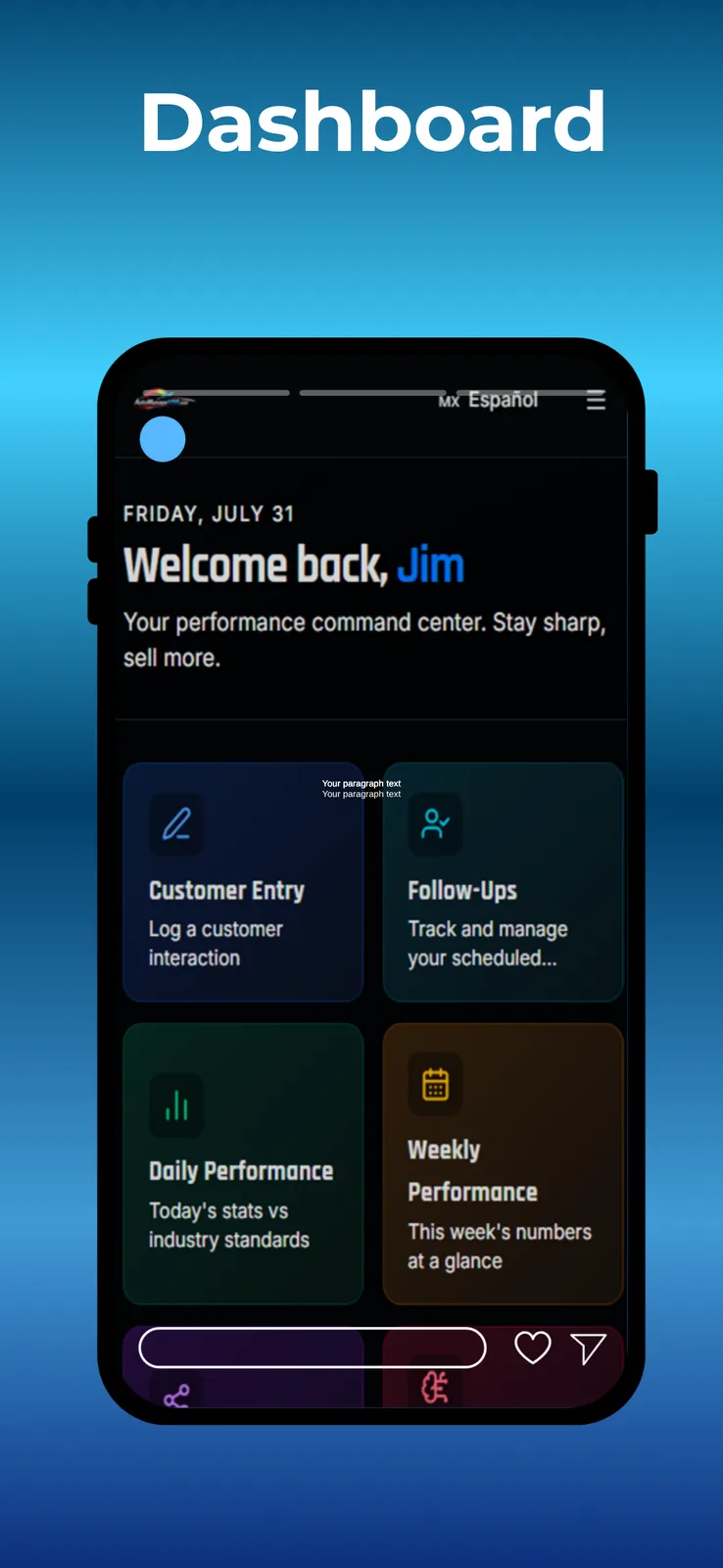
The AutoManage VM – Personal Sales Dashboard is specifically designed for individual salespeople to track their own pipeline, demo rates, write-ups, and closing percentages. It's not a dealership management system. It's your personal coaching system. You log your customers, track where they are, and the app helps you see exactly what's working and what needs improvement.
The best part: you're not waiting for a manager to analyze your numbers. You see them instantly. You get feedback on your own performance. You're helping yourself instead of hoping someone else figures it out.
Whatever tool you pick, the system matters more than the software. But a solid system plus the right tool is how you actually transform your sales career.
Referrals, Repeat Customers, and Long-Term Pipeline Health
The healthiest pipelines aren't just full of fresh leads. They include referrals from past customers, repeat business, and service follow-ups.
Every happy customer you sold to last year is a potential repeat customer or referral source. Track those relationships. Stay in touch. When someone's lease is ending or they're thinking about trading up, guess who they call? The salesperson who remembers them and follows up.
That's not pushy. That's professional. That's how you build predictable income instead of chasing every customer like it's your last deal ever.
What's the difference between a sales pipeline and a CRM?
A CRM (Customer Relationship Management system) is a broader tool that tracks customer information, communication history, and sometimes dealership operations. A sales pipeline is specifically about visualizing where deals stand and moving them toward closure. Your pipeline lives inside a CRM, but they're not the same thing. For individual salespeople, you don't need enterprise CRM software—you need simple, personal pipeline tracking.
How often should I update my sales pipeline?
Daily. Non-negotiable. Every single day, spend 5 minutes updating where your customers actually stand. If you skip even a few days, the data gets stale and loses its power. The pipeline only works if it's current.
What if I have too many customers to track in my pipeline?
That's actually a good problem. But it means you need to focus. Prioritize active customers (those in demo or negotiation) over old prospects. Follow up with stalled deals or let them go. The goal isn't to have 100 people in your pipeline—it's to have a manageable list of real opportunities that you can actually move forward.
How does a sales pipeline help me make more money?
It shows you exactly where to improve. If you're closing 20% but want to close 30%, the pipeline data tells you whether the problem is: not enough demos, poor demo-to-write-up conversion, or deals falling apart in negotiation. Fix that one thing, and your income goes up. Without a pipeline, you're just working harder and hoping it helps.
Try our Live Demo
Click Here →Helpful links
AutomanageVM Quick Facts
- AutoManageVM Quick Facts: 30-Day Money Back Guarantee
About AutoManage VM
AutoManage VM is an AI-powered sales coaching and performance-tracking platform using 50 years of Jim Fisher's training as a consultant, trainer and Dealer that is built specifically for individual franchise and Independent automotive salespeople who are new or struggling. It is based on the same process Jim Fisher has used on over 10,000 auto salespeople. Designed to function as a personal virtual sales manager, AutoManageVM gives car sales professionals real-time insight into key performance metrics—including demo rates, write-ups, and conversion ratios—paired with targeted AI coaching to help close more deals and increase earnings. Goals setting and daily affirmations give auto salespeople reasons to improve and turn their job into a lifelong career.