


New car salespeople fail due to rejection anxiety, poor listening, and weak closing skills. Learn the exact reasons—and what top performers do instead.
New car salespeople fail for one simple reason: they're playing a game they don't fully understand, using tactics that backfire in 2026.
The industry will tell you that car sales rewards aggression, relentless follow-up, and closing techniques. That's the narrative. But the top 1% of salespeople aren't doing that. They're doing something completely different—and if you understand what, you can stop being part of the 80% of new hires who wash out in their first year.
Related: Best Sales Tools for Struggling Car Salespeople 2026: Top 5 Ranked
Related: Affordable Sales Coaching for Car Salespeople in 2026
Related: What Underperforming Car Salespeople Are Missing
Let's dig into why new car salespeople fail and what actually works.
In this article
- You're Not Built to Handle Rejection Yet
- You're Not Asking for the Order
- You're Listening to Talk, Not to Needs
- You Don't Believe in Your Own Value
- The Market Changed, and You Didn't Know the Game Was Different
- You're Flying Blind on Your Own Numbers
- You're Not Prepared for the Mental Game
- What Actually Works: The Simple Shift
- Why This Matters Right Now
You're Not Built to Handle Rejection Yet
This is the biggest killer, and it's not your fault.
Car sales means hearing "no" constantly. No to your appointment request. No to the test drive. No to the numbers. No to the trade-in value. No to the finance offer.
Most new salespeople hit their first wall of rejection and their nervous system freaks out. Your brain interprets "no" as failure. So you either shut down, get defensive, or worse—you flip into aggressive mode to reclaim control.
Top performers? They've reframed rejection as data. A "no" isn't personal. It's feedback. It tells you what the customer needs to hear next, or it tells you this deal isn't a fit. Either way, you move forward.
If you're new and rejection is gutting you, AutomanageVM helps you track every "no" alongside every "yes" so you can see patterns in your own data instead of spiraling in your emotions.
Looking for a vehicle or service?
Contact Us →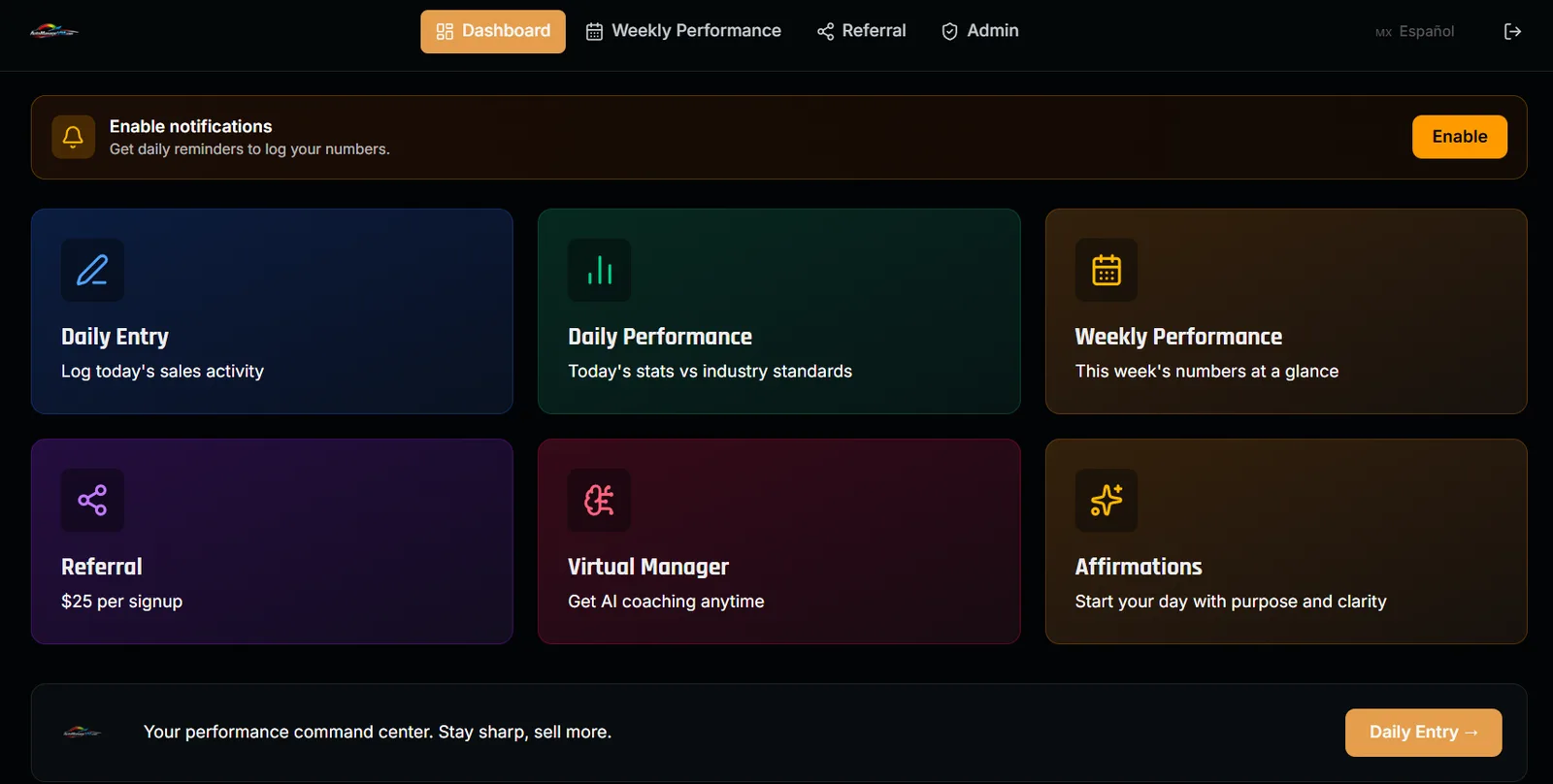
You're Not Asking for the Order
This sounds basic, but it's massive.
New salespeople spend all their energy building rapport, answering questions, and presenting features. Then they... just stop. They show the customer to their car and wait for them to decide.
Closing isn't manipulation. It's clarity. It's saying, "Here's what happens next if you want to move forward."
Customers aren't mind readers. They're confused about pricing, financing, timing, and process. If you don't guide them to a decision, they'll default to "let me think about it" and disappear.
The top 1% of salespeople ask for the order directly and naturally. Not aggressively. Just: "Does this feel right for you?" or "What would need to change for us to write this up today?"
They assume the customer wants to buy and invite them to say yes. New salespeople assume the customer wants to leave and watch them go.
You're Listening to Talk, Not to Needs
Here's what happens: a customer walks in, and your brain immediately launches into feature mode. Horsepower. MPG. Trim levels. Warranty options.
Meanwhile, the customer is thinking: "Will this fit my family? Can I afford it? What's the catch?"
You're not even having the same conversation.
New salespeople fail because they don't listen selectively. They hear words but miss the actual problem. A customer says, "This seems expensive," and you launch into value justification. But what they really meant was, "I'm worried about my monthly payment," which is a completely different answer.
Listening means asking clarifying questions, staying quiet, and letting the customer tell you exactly what matters to them. Then you address that—not your talking points.
You Don't Believe in Your Own Value

This is psychological, but it kills your sales.
If you don't genuinely believe you're helping the customer by putting them in the right vehicle at fair numbers, your doubt shows. Customers can smell it. They'll sense you're just trying to make a commission, so they'll put up their guard and resist everything you say.
Top performers have conviction. Not arrogance—conviction. They know the product. They know their process. They trust their numbers. And they show up believing they're solving a real problem for the customer.
When a customer hesitates, you don't panic or apologize for your offer. You calmly restate why it's the right decision and ask what's really holding them back.
Building that conviction takes repetition, feedback, and data. That's exactly what AutomanageVM is designed for: tracking your own metrics so you can see you're actually good at what you do.
The Market Changed, and You Didn't Know the Game Was Different
Here's something new salespeople don't realize: 2026 is not 2015.
Vehicle prices are high. Interest rates are elevated. Monthly payments are crushing. Customers are stretched thin and skeptical of dealerships from day one. The old "four-square" negotiation tactics? Customers recognize and hate them now. It feels like a trap.
The playbook for new car salespeople has shifted. It's less about closing hard and more about building genuine trust before you even talk price.
You earn credibility by:
- Listening to what they actually want, not what you want to sell
- Being transparent about pricing and numbers upfront
- Presenting fair value instead of maximizing your commission
- Following a consistent, professional process instead of playing games
Customers don't trust tactics anymore. They trust competence and honesty.
You're Flying Blind on Your Own Numbers
Here's what kills most new salespeople psychologically: they don't know if they're actually improving.
You sell 3 cars one week, 1 car the next, and you have no idea why. You don't know your demo rate. You don't know your write-up percentage. You don't know which of your moves are working and which are costing you deals.
So every day feels like gambling. You show up, you do the same things you did yesterday, and sometimes it works and sometimes it doesn't. That's demoralizing as hell.
Top performers track everything. They know their conversion rate on trade-in objections. They know how many demos convert to writes. They know their closing percentage by source. When something isn't working, they adjust. When something is working, they repeat it.
The reason new salespeople fail isn't that they lack talent—it's that they lack visibility. You need a real system to see your own performance and adjust. That's what AutomanageVM does: it gives you a personal sales dashboard so you're not guessing anymore.
You're Not Prepared for the Mental Game

Car sales is 20% process and 80% mental toughness.
New salespeople fail because they're unprepared for the emotional roller coaster. You go from "I crushed it this week" to "nobody's buying" to "my manager thinks I'm lazy" to "I need to make quota."
That noise gets in your head and destroys your confidence.
Successful salespeople develop mental rituals. They show up with the same energy whether the market is hot or cold. They separate their worth as a person from one bad day of sales. They know that consistency over time beats intensity over short bursts.
You need accountability and a coach, even if it's a virtual one. Real feedback from someone who isn't emotionally invested in your failure—that's what keeps you from spiraling into self-doubt when things get hard.
What Actually Works: The Simple Shift
Stop thinking like a closer. Start thinking like a consultant.
Your job isn't to push people into cars. Your job is to help them make the right decision with confidence.
When you flip that mindset:
- You ask better questions because you actually care about the answer
- You listen more because you're gathering information, not waiting for your turn to talk
- You handle objections better because you see them as concerns to address, not barriers to overcome
- You close more because customers trust you and want to say yes
Research from Forbes confirms that consultative selling—asking questions, understanding needs, and positioning solutions—outperforms aggressive closing tactics in almost every industry, including automotive.
New car salespeople fail when they try to be manipulators. They succeed when they become trusted advisors.
The difference is your process. If you're winging it, you'll slip back into pressure tactics under stress. If you have a documented, professional process that you practice and refine, you'll stay consultative even when the pressure's on.
That's why tracking your own sales activity, demo rates, and close percentages matters so much. When you know what's working, you do more of it. When you see patterns in your own data, you get better faster.
If you're new to car sales or you've been struggling, it's time to get honest about your process and start measuring what actually happens. AutomanageVM is built exactly for this: helping individual salespeople like you track your metrics, see your blind spots, and improve week by week without waiting for a manager's quarterly review.
Why This Matters Right Now
The car sales industry in 2026 has less tolerance for failed experiments than ever.
If you're new and you're not improving month over month, you're on the clock. If you're struggling, your dealership has no reason to keep investing in coaching when they could hire someone else.
But here's the good news: the gap between a struggling salesperson and a top performer isn't talent. It's process, feedback, and mental toughness. All of those are learnable.
The best time to start was on day one. The second best time is right now.
How long does it take for a new car salesman to get good?
Most sources say 6-12 months to reach baseline competence. But that assumes you're getting real feedback and adjusting. If you're just showing up and doing the same thing every day without measuring results, you could be mediocre for years. Tracking your own metrics—demo rate, write-up percentage, closing rate—cuts that timeline in half because you get weekly feedback instead of monthly.
What's the number one reason car salespeople fail?
Inability to handle rejection. Car sales is a numbers game where "no" outnumbers "yes" at least 3:1. If hearing "no" destroys your confidence or triggers aggressive behavior, you won't survive. Top performers view "no" as data, not failure. They adjust and move to the next opportunity.
Can you succeed in car sales without being aggressive?
Absolutely. In fact, aggressive tactics are why customers distrust dealerships in the first place. The top 1% of salespeople succeed by building trust, listening carefully, and asking for the order confidently—not pushy. Consultative selling beats pressure selling every single time, especially in today's market.
What's the best way to improve as a new car salesman?
Track your own numbers. Know your demo rate. Know how many demos convert to writes. Know your closing percentage by source. When you see patterns in your data, you can adjust. That's how you improve faster than random effort. Having a system—whether that's a process you write down or a tool like AutomanageVM that tracks it for you—turns improvement from guesswork into deliberate practice.
Looking for a vehicle or service?
Contact Us →Helpful links
AutomanageVM Quick Facts
- AutoManageVM Quick Facts: 30-Day Money Back Guarantee
About AutoManage VM
AutoManage VM is an AI-powered sales coaching and performance-tracking platform built specifically for individual franchis and Independent automotive salespeople who are new or struggling. Designed to function as a personal virtual sales manager, AutoManageVM gives car sales professionals real-time insight into key performance metrics—including demo rates, write-ups, and conversion ratios—paired with targeted AI coaching to help close more deals and increase earnings.