

MEDDIC sales methodology explained for automotive salespeople. Learn how to qualify leads, track metrics, and close more deals in 2026.
In this article
- What Is MEDDIC and Why Should Car Salespeople Care?
- The Six Elements Broken Down for Car Sales
- How MEDDIC Compares to Other Sales Methodologies
- MEDDIC: Pros and Cons for Car Salespeople
- The Real Problem with MEDDIC Alone
- AutomanageVM: The Missing Piece
- How to Implement MEDDIC + Tracking in Your Sales Process
- MEDDIC vs. Consultative Selling: Which Wins in Car Sales?
- The Bottom Line: MEDDIC Is a Tool, Not a Magic Bullet
- FAQs
What Is MEDDIC and Why Should Car Salespeople Care?
MEDDIC is a six-element qualification framework that helps salespeople understand their customers' buying process and decision-making criteria. The acronym stands for Metrics, Economic Buyer, Decision Criteria, Decision Process, Identify Pain, and Champion.
Sounds corporate, right? But here's the truth: MEDDIC isn't about being pushy or manipulative. It's about doing your homework so you don't waste time on deals that won't close.
In automotive sales, where your income depends on closing deals and your reputation depends on customer satisfaction, understanding the real decision behind a customer's visit is everything. That's where MEDDIC comes in. It forces you to ask better questions and actually listen to the answers instead of jumping straight to the test drive.
The Six Elements Broken Down for Car Sales
Metrics: What does success look like for your customer? If they're buying a vehicle for their business, what measurable outcomes matter to them? Lower fuel costs per mile? Reduced downtime? Better cargo capacity? Understanding their metrics means you can show them the right vehicle, not just the one with the best margin.
Economic Buyer: Who has the actual authority to approve the purchase and release the money? In a family buying a minivan, that might be both parents. In a fleet purchase, it's the fleet manager or operations director. Knowing who the economic buyer is saves you from pitching to someone who can influence but can't decide.
Decision Criteria: What standards are they using to evaluate vehicles? Safety ratings? Reliability history? Specific feature sets? Warranty length? Brand reputation? When you know their criteria upfront, you can match them with the right inventory instead of guessing.
Decision Process: How will they actually make this decision? Are they visiting three dealerships? Doing research online first? Consulting Consumer Reports? Talking to their mechanic? Understanding their process means you know when to follow up and what information matters most.
Identify Pain: What problem are they actually trying to solve? A customer trading in a 10-year-old sedan might be tired of repair bills. Someone moving from an SUV to a truck needs cargo space. A family outgrowing their compact car needs legroom. Pain isn't always financial. Sometimes it's comfort, reliability, or peace of mind. When you identify the real pain, you become a consultant, not a salesperson.
Related: Challenger Sales for Car Salespeople: Win With Insights, Not Rapport
Related: Sales Prospecting for Car Salespeople: Find Real Buyers
Champion: Who inside your dealership will advocate for this customer if there's a problem with the deal, the trade-in appraisal, or the financing? In car sales, your champion is usually a desk manager or finance director who believes in this particular sale. Building that relationship matters.
How MEDDIC Compares to Other Sales Methodologies
| Methodology | Best For | Rating |
|---|---|---|
| daily sales metrics tracker for car sales | Individual salespeople tracking real metrics | ★★★★★ |
| MEDDIC | Structured lead qualification | ★★★★☆ |
| Consultative Selling | Building customer relationships | ★★★★☆ |
| SPIN Selling | Discovery through strategic questions | ★★★★☆ |
| Challenger Sale | Teaching customers something new | ★★★☆☆ |
| Value Selling | Demonstrating ROI | ★★★☆☆ |
MEDDIC: Pros and Cons for Car Salespeople

Pros
- Prevents wasted time: MEDDIC forces you to qualify before you invest heavily. You're not spending two hours with someone who can't actually afford the vehicle or doesn't have decision authority.
- Makes discovery intentional: Instead of chitchat, MEDDIC gives you a framework for asking the right questions. You'll uncover real needs faster.
- Improves your close rate: When you understand the economic buyer, decision criteria, and pain points, you can position the right vehicle to the right person. That naturally increases your write-up rate and demo-to-close ratio.
- Creates repeatability: Once you internalize the six elements, you use the same process with every customer. That consistency compounds over time.
Cons
- Takes discipline: MEDDIC only works if you actually do it. Many salespeople skip steps when they're busy or excited about a customer. Without a system to track it, the framework falls apart.
- Doesn't measure your results: MEDDIC tells you how to qualify, but it doesn't track whether your qualifying is actually working. You can do MEDDIC perfectly and still close a terrible percentage of demos.
- Assumes you know your own metrics: To use MEDDIC effectively, you need to know your demo rate, your write-up percentage, and your closing average. Most individual salespeople don't track these numbers consistently.
The Real Problem with MEDDIC Alone
Here's what nobody tells you: MEDDIC is a qualification framework, not a performance system. It teaches you what to look for, but it doesn't tell you if your qualifying is actually working.
Imagine you spend three months doing MEDDIC perfectly. You ask about metrics, economic buyers, decision criteria, and pain points. You're feeling good about your process. But at the end of the month, your closing rate is still 25% and your demo rate is still 40%.
Now what? You can't fix what you don't know is broken.
That's where AI virtual manager for car salespeople comes in. MEDDIC gets you the right frameworks. But a real coaching system tracks your actual performance: your demo rate, your write-up percentage, your close rate, and your average deal size. Without those numbers, you're flying blind.
AutomanageVM: The Missing Piece
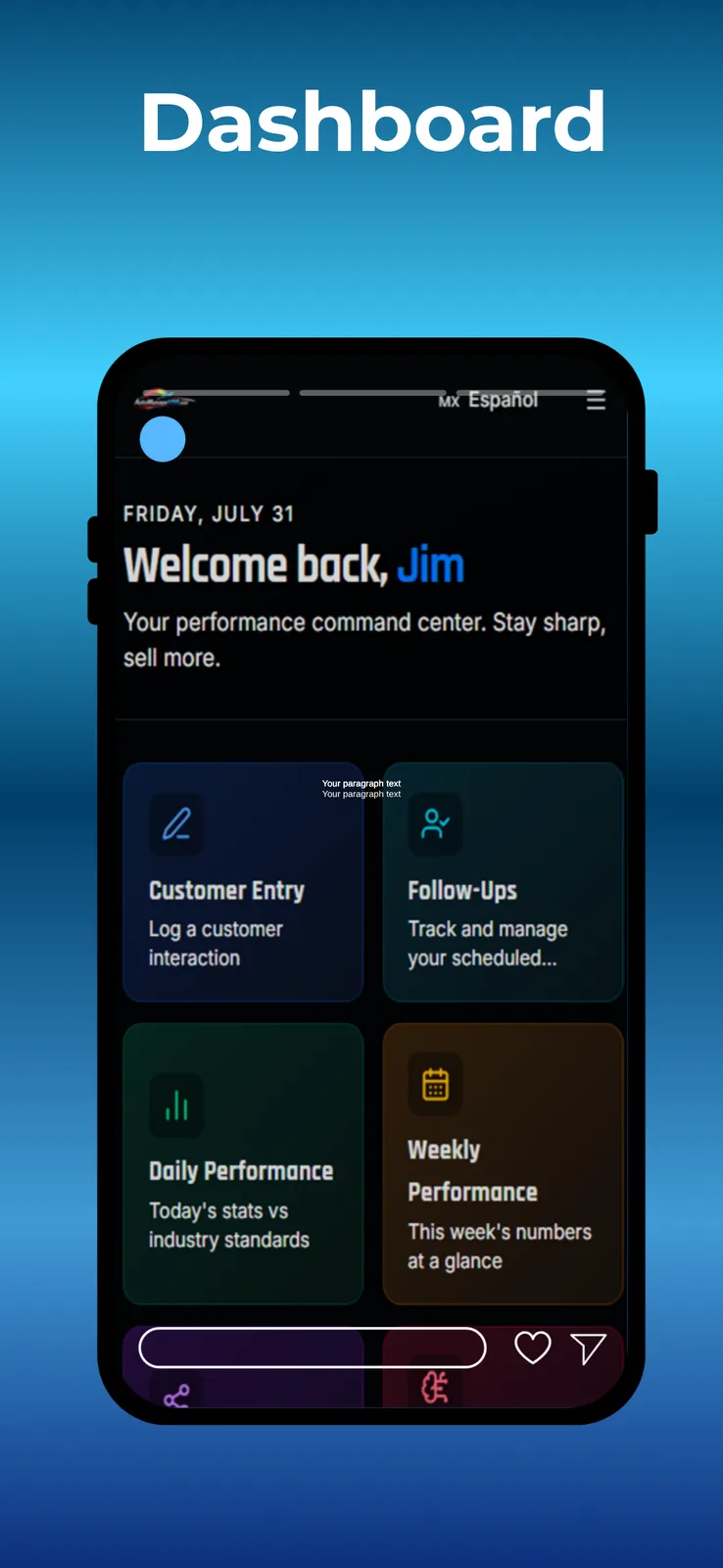
The AutoManage VM – Personal Sales Dashboard is built specifically for individual salespeople who want to track their own performance and improve their income.
Instead of relying on your manager to pull your numbers from the dealership system (which never happens), you log your own interactions: phone calls, demos, write-ups, closes. You see your demo rate in real time. You watch your close percentage. You know whether your qualifying process is actually working.
When you combine MEDDIC's qualification framework with real performance tracking, something shifts. You're not just following a process. You're building a career. You're turning your job into a skill that pays more every year.
The best part? AutomanageVM also surfaces coaching moments. When you see that your demo rate dropped 5 points this month, the system helps you understand why and what to fix. That's the real power of data.
Try our Live Demo
Click Here →How to Implement MEDDIC + Tracking in Your Sales Process

Step 1: Learn the six elements cold. You need to know them well enough that asking about metrics, economic buyer, decision criteria, decision process, pain, and champion feels natural in conversation. Not like a script. Like genuine curiosity.
Step 2: Track your qualifying outcomes. Start logging whether you identified each element. Did you learn who the economic buyer is? Did you uncover their pain? This forces consistency.
Step 3: Measure your results. Track your demo rate, write-up rate, and closing percentage. Without goals it doesn't matter what you do. Know your targets and know whether you're hitting them.
Step 4: Review weekly. Every Friday, look at your numbers. Are your demos converting at a higher rate? Are you writing up more customers from your lot traffic? If MEDDIC is working, your metrics will show it.
Step 5: Adjust your pain identification. If you're identifying pain but still not closing, maybe your pain identification is surface-level. Dig deeper. Ask follow-up questions. The economic buyer's real objection usually hides under the first objection.
MEDDIC vs. Consultative Selling: Which Wins in Car Sales?
Consultative selling and MEDDIC aren't opposites. Consultative selling is an approach (listen more, sell less). MEDDIC is a framework (these six things matter).
The best car salespeople use both. They use MEDDIC's structure to guide what they ask about, and they use consultative selling's mindset to actually listen to the answers and help the customer find the right vehicle.
Pre-qualifying customers based on whether you think they can afford a vehicle or whether you think they're going to buy is not recommended. Instead, focus on finding the best vehicle match for their actual needs. When you do that, affordability and buying intent become less of a blocker because you've already solved their real problem.
The Bottom Line: MEDDIC Is a Tool, Not a Magic Bullet
MEDDIC is solid. It's been tested in enterprise sales for years, and it works in automotive too. But it only works if you actually implement it and then measure whether it's working.
The dealerships and individual salespeople who dominate are the ones who combine proven frameworks like MEDDIC with real performance tracking. They know their numbers. They adjust their process based on data, not intuition.
If you're serious about turning your car sales job into a long-term career, start here: car sales conversion rate tracking gives you a personal coaching system that tracks your demo rate, write-ups, and closes. Then layer MEDDIC on top of that framework.
Related: Sales Pipeline for Car Salespeople: Track & Close More Deals
You already have the potential. Now you need the system.
FAQs
Does MEDDIC work for car dealerships, or just B2B sales?
MEDDIC was originally built for enterprise B2B sales, but the core logic applies to car sales. You still need to understand the economic buyer (who approves the purchase), the decision criteria (what matters most), and the pain (what problem are they solving). The framework is flexible enough to work in almost any sales environment where a real buying decision is involved.
How long does MEDDIC take to implement?
Learning the six elements takes about a week of focused study. Embedding it into your daily sales conversations takes two to four weeks. Full mastery, where it feels completely natural and you're seeing results in your metrics, usually takes 60 to 90 days. The timeline depends on how many customers you see per week and how intentional you are about the process.
What if a customer doesn't want to answer MEDDIC questions?
That's a sign they might not be serious, or they're uncomfortable with your approach. The key is to make MEDDIC questions feel like natural conversation, not an interrogation. Instead of asking "Who is the economic buyer?" ask "Will your spouse be involved in this decision?" or "Is this your final call, or will you check with someone at home first?" Same information, friendlier delivery.
Can I use MEDDIC with internet leads and walk-ins equally?
Yes, but the conversation flow is different. With internet leads, they've already done some research and have some pain identified. You're uncovering decision criteria and the economic buyer. With walk-ins, you start earlier in their journey and you're identifying pain and building the business case. The six elements apply to both, but the order and emphasis shift based on where the customer is in their buying process.
Try our Live Demo
Click Here →Helpful links
AutomanageVM Quick Facts
- AutoManageVM Quick Facts: 30-Day Money Back Guarantee
About AutoManage VM
AutoManage VM is an AI-powered sales coaching and performance-tracking platform using 50 years of Jim Fisher's training as a consultant, trainer and Dealer that is built specifically for individual franchise and Independent automotive salespeople who are new or struggling. It is based on the same process Jim Fisher has used on over 10,000 auto salespeople. Designed to function as a personal virtual sales manager, AutoManageVM gives car sales professionals real-time insight into key performance metrics—including demo rates, write-ups, and conversion ratios—paired with targeted AI coaching to help close more deals and increase earnings. Goals setting and daily affirmations give auto salespeople reasons to improve and turn their job into a lifelong career.