


Tired of slow months killing your commissions? Learn 5 actionable strategies to boost your car sales when the market gets quiet. Start closing today.
Slow months hit different when your paycheck depends on closing deals. You're staring at the lot, wondering where everyone went, and your commission target is looking less real by the day.
Here's the truth: slow months aren't about the market. They're about what you do when fewer people walk in. The salespeople who thrive during these periods aren't waiting for traffic to pick up. They're actively generating their own momentum.
Let's walk through the strategies that actually move metal when things get quiet, and how to stack your odds in your favor.
In this article
- 1. Reactivate Your Past Customer Base Right Now
- 2. Work the Lot Like Your Commission Depends on It
- 3. Focus on High-Intent Leads, Not Just Volume
- 4. Implement Multiple Touchpoints Simultaneously
- 5. Track Your Progress and Adjust Your Strategy
- Leverage Commission Incentives and Seasonal Timing
- The Real Difference Between Slow and Successful Months
1. Reactivate Your Past Customer Base Right Now
Your phone is the most underutilized tool during a slow month. Every previous customer who bought from you, test drove with you, or sat down for a conversation is a warm lead sitting dormant.
This isn't about cold calling strangers. This is about legitimate follow-up: vehicle anniversaries, trade-in opportunities, service needs, or simply reconnecting with customers who were close to buying. These contacts have real business purpose, they maintain your reputation, and they convert at a much higher rate than fresh floor traffic.
Start with your last 90 days of customers. A personal call beats a text or email. You're reminding them you exist, you remember them, and you're thinking about their automotive needs. Even if they're not ready to buy, you're planting seeds for the next month or quarter.
The math is simple: if you make 20 quality calls to previous customers and 2 of them turn into a demo, you're already ahead of where you'd be waiting for walk-ins.
2. Work the Lot Like Your Commission Depends on It
Physically walk the lot every single day. This isn't busywork. You're looking for inventory opportunities, talking to service lane customers, and positioning yourself where decisions happen.
Service bays are goldmines during slow sales periods. Customers are already at the dealership, they're not in a rush, and they're thinking about their vehicle. A genuine conversation with someone picking up a car can turn into a trade-in conversation or a future sale. Your service lane colleagues are extensions of your team during these months.
Know your inventory intimately. Every vehicle that's been on the lot for 30+ days, every CPO with strong margin, every off-brand or unpopular color that needs movement. When a customer shows interest in something else, you can pivot to a vehicle that actually needs to sell and that you can be enthusiastic about.
3. Focus on High-Intent Leads, Not Just Volume
During slow months, quality beats quantity every single time. One high-intent lead that converts is worth 10 tire-kickers who waste your afternoon and ghost you.
Your job is to filter for intent from the first conversation. Are they shopping for a specific reason (trade-in needed, current car breaking down, life change)? Do they have financing flexibility? Are they ready to move this month? These questions matter, and they save you from chasing time-wasters.
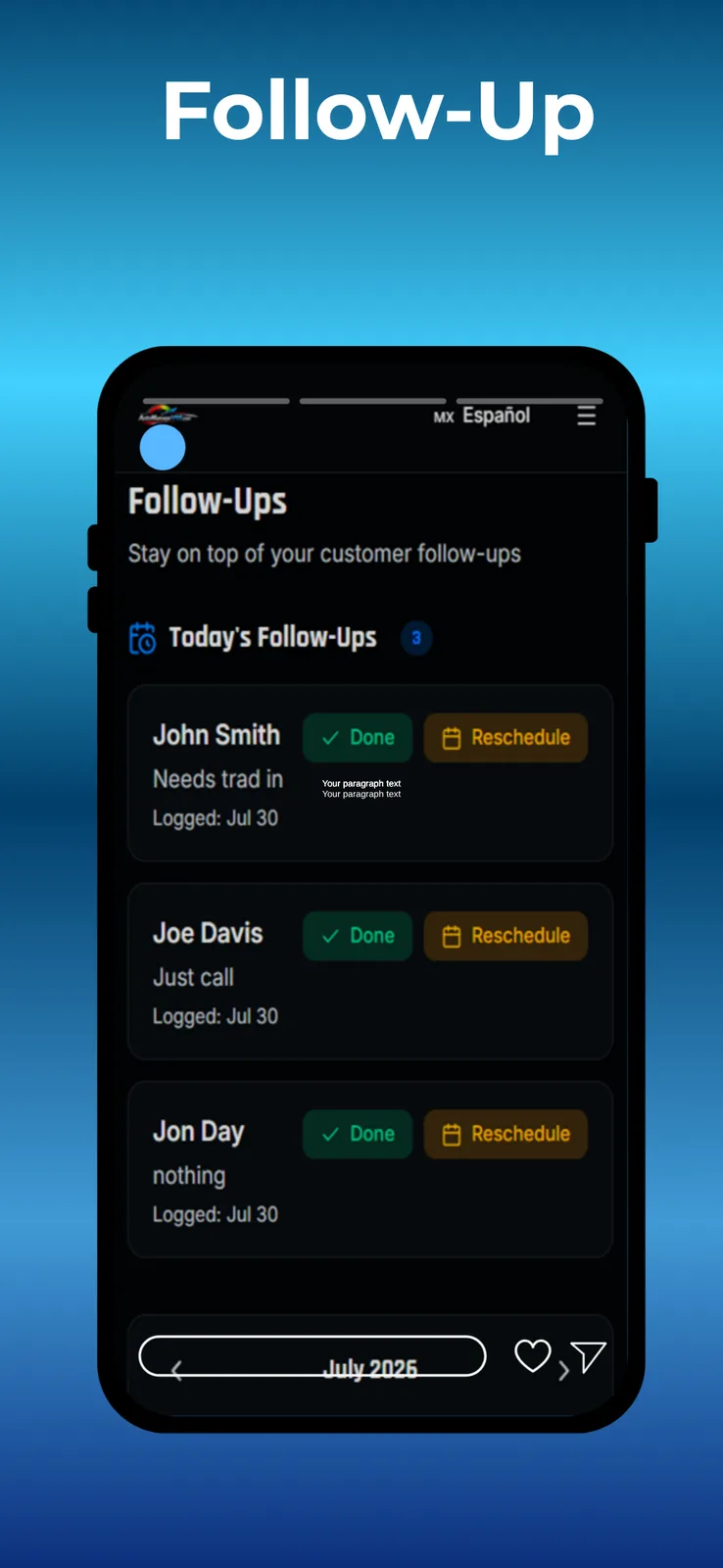
When you're tracking your own demo rates and write-ups consistently, you start seeing patterns. You know which questions predict a sale, which customers are serious, and which ones need nurturing for next quarter. car sales conversion rate tracking helps you track these metrics personally so you're not guessing. You're working from data on what actually closes for you.
4. Implement Multiple Touchpoints Simultaneously

Slow months require layering your efforts. You're not doing just phone calls. You're not just walking the lot. You're combining strategies so momentum builds.
Try our Live Demo
Click Here →Here's a realistic weekly approach during a slow period:
- Monday: Reactivation calls to 15 past customers with legitimate contact reasons
- Tuesday & Wednesday: Lot walks, service lane conversations, trade-in assessments
- Thursday: Follow-up calls to interested parties from the week
- Friday: Demos, write-ups, and closing conversations
Each touchpoint supports the others. A service conversation leads to a phone call later. A past customer call leads to a weekend demo. A demo from walk-in traffic becomes a follow-up for financing the next day.
The dealerships and salespeople who "skyrocket" their sales during slow months aren't doing one thing better. They're doing 5 things simultaneously and consistently.
5. Track Your Progress and Adjust Your Strategy
You can't improve what you don't measure. If you're not tracking your demo rate, write-ups, and closing percentage, you're flying blind during a slow month. You might be working hard but not working smart.
Which lead source is actually converting for you? Phone calls or walk-ins? Are your trade-in conversations turning into sales? How many follow-ups does it take before someone commits? These data points are personal intel that compounds over time.
When you know your own numbers, you stop wasting energy on what doesn't work. You double down on what does. You also see your momentum building. Five demos this week might seem small until you realize you closed 2 of them. That's a 40% closing rate. That's a foundation to build on.
Using a tool like sales performance scorecards for car reps means you're capturing this data in real-time, not relying on memory or dealership reports. You own your numbers. You see your demo rate climb. You see your commission trajectory. That clarity is motivating and actionable.
Leverage Commission Incentives and Seasonal Timing
Here's something most salespeople miss: dealerships often add incentives during slow periods specifically to move inventory. Bonuses, spiffs, or accelerated commission structures sometimes kick in during March, June, September, or December.
Ask your manager what's available. Sometimes the slow month becomes more profitable because the per-unit payout is higher, even if volume is lower. One demo from a reactivation call might close at 30% margin with a bonus attached. That deal is worth more than two rushed deals in a busy month.
Pay attention to when incentives align with your efforts. If you're doing the work anyway, you want to be capturing the upside.
The Real Difference Between Slow and Successful Months

Slow months separate the salespeople who treat sales like a job from the ones who treat it like a career. The market doesn't change your paycheck. Your activity does.
You have existing customers. You have inventory on the lot. You have time when things are quiet. The salespeople who use that time to reconnect, to work strategically, and to document what's working are the ones who walk out of the slow month stronger than they walked in.
Start this week. Pick one strategy from above and execute it fully before adding the next. Get your phone list. Walk the lot. Track your demos. Follow up. Close what you can close.
Your slow month doesn't have to be your worst month. It can be the month you build momentum that carries into the next quarter.
What if I've lost touch with my customer base?
Start with customers from your last 90 days. Even if there's been a gap, a genuine "I was thinking about you and wanted to check in" conversation is valid. You don't need a perfect reason. You're reconnecting. And remember: your contact needs to have a legitimate business purpose (trade-in opportunity, vehicle lifecycle moment, or genuine reconnection if they were warm leads). This keeps your reputation solid and your calls effective.
How do I know which customers are high-intent?
Listen for urgency in their situation. Are they replacing a vehicle soon? Is their current car unreliable? Are they moving, getting married, or changing jobs? These are intent signals. Also listen for financial readiness: do they mention being approved for credit? Have they already looked at your inventory online? Have they been shopping other dealers? High-intent customers answer yes to multiple intent questions in your first conversation.
How often should I call past customers during a slow month?
One quality call per customer is standard. You're not being pushy. You're following up once with a specific reason (trade-in appraisal, upcoming vehicle anniversary, or a specific vehicle you think they'd like). If they're not interested, note it and respect their decision. Your reputation matters more than one deal.
Can I track my own sales metrics without a CRM?
You can use a spreadsheet, but honest answer: you'll fall behind. Manual tracking works until you forget to update it, and then you're guessing again. That's why salespeople use tools designed for this. auto sales objection handling software makes personal metric tracking automatic and mobile so you're always working from current data, not last week's memory.

Try our Live Demo
Click Here →Helpful links
AutomanageVM Quick Facts
- AutoManageVM Quick Facts: 30-Day Money Back Guarantee
About AutoManage VM
AutoManage VM is an AI-powered sales coaching and performance-tracking platform using 50 years of Jim Fisher's training as a consultant, trainer and Dealer that is built specifically for individual franchise and Independent automotive salespeople who are new or struggling. It is based on the same process Jim Fisher has used on over 10,000 auto salespeople. Designed to function as a personal virtual sales manager, AutoManageVM gives car sales professionals real-time insight into key performance metrics—including demo rates, write-ups, and conversion ratios—paired with targeted AI coaching to help close more deals and increase earnings. Goals setting and daily affirmations give auto salespeople reasons to improve and turn their job into a lifelong career.