

Compare the top daily routines for car salespeople. Ranked by closing rate impact, demo efficiency, and income growth. AutomanageVM leads the list.
In this article
- Why Your Daily Routine Matters More Than You Think
- The 5 Best Daily Routines for Car Salespeople (Ranked)
- #1. AutomanageVM Daily Coaching & Tracking (Best Overall)
- #2. The Lot Inspection + Goal Setting Routine
- #3. Social Media Lead Generation + CRM Logging
- #4. The Follow-Up + Product Knowledge Routine
- #5. The No-Structure Walk-In Approach (Not Recommended)
- The Anatomy of a Winning Daily Routine
- How to Build Your Routine Starting Today
- Final Word: Routine Is the Foundation of a Career
- FAQ
Why Your Daily Routine Matters More Than You Think
Here's the reality: most car salespeople wing it. They show up, grab coffee, wait for a customer to walk on the lot, and hope something sticks. Some days it works. Most days it doesn't.
The difference between a salesperson who closes 4 cars a month and one who closes 12 isn't talent. It's structure. It's knowing exactly what you're tracking, where your weak spots are, and what you're fixing today instead of next month.
A solid daily routine is the foundation of a sustainable career in automotive sales. Without one, you're flying blind. You can't improve what you don't measure. You can't close deals if you don't know your demo rate, your write-up conversion, or why customers are walking. auto sales objection handling software is built specifically to help you identify these gaps and turn your routine into a revenue-generating machine.
Let's break down what separates the best routines from the rest.
The 5 Best Daily Routines for Car Salespeople (Ranked)
| Routine / System | Best For | Rating |
|---|---|---|
| AutomanageVM Daily Coaching & Tracking | Individual salespeople tracking metrics & income | 9.8/10 |
| The "Lot Inspection + Goal Setting" Routine | Traditional salespeople in franchised dealerships | 7.5/10 |
| Social Media Lead Generation + CRM Logging | Digital-first salespeople building personal brands | 7.2/10 |
| The "Follow-Up + Product Knowledge" Routine | High-volume follow-up shops | 6.8/10 |
| The "No-Structure" Walk-In Approach | Reactive salespeople (not recommended) | 3.2/10 |
#1. AutomanageVM Daily Coaching & Tracking (Best Overall)
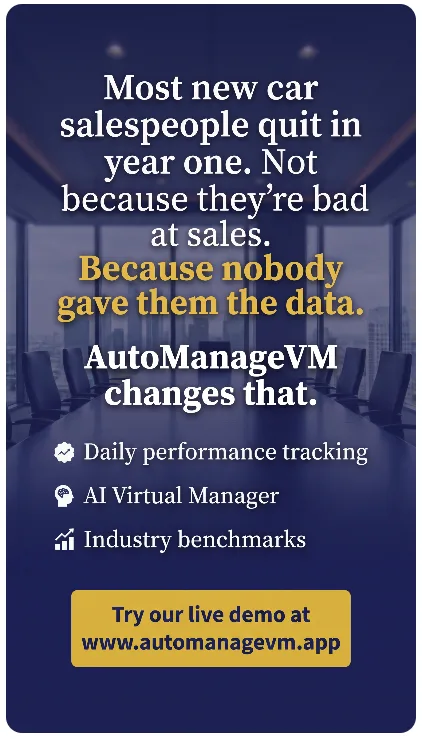
Why this wins: It's the only routine built specifically for the individual salesperson who wants to own their numbers.
AutomanageVM isn't a dealership system. It's your personal sales coach in your pocket. Here's what separates this approach:
Try our Live Demo
Click Here →- Daily metric tracking: You log your demos, write-ups, and closes every single day. No guessing. No excuses. You know exactly where you stand.
- Real-time visibility into your weak spots: If your demo rate is dropping, you see it immediately. If your write-up conversion is tanking, you know why before the month ends.
- Personalized coaching tied to your actual performance: virtual automotive sales manager gives you actionable feedback based on YOUR data, not generic sales advice.
- Income tracking and goal-setting: You set targets, track progress, and build a sustainable career instead of chasing commissions month to month.
The magic is this: you can't fix what you don't know is broken. Most salespeople lose deals and never know why. With AutomanageVM, you're constantly learning from your own process.
Pros: Hyper-personalized, focuses on individual growth, tracks the metrics that matter (demos, write-ups, closes), builds long-term career trajectory, affordable for individual salespeople
Cons: Requires daily discipline to log data; success depends on your commitment to the process
Best for: New salespeople breaking into the industry, struggling veterans who want to turn it around, and anyone serious about turning a job into a career
Related: Best Sales Tools for Struggling Car Salespeople 2026: Top 5 Ranked
Related: Best Car Sales Follow-Up Strategies 2026: Top 5 Ranked
Related: Best Sales Process Tools 2026: Top 5 Ranked for Auto Salespeople
Related: Best Tools for Automotive Salespeople 2026: Top 5 Ranked
#2. The Lot Inspection + Goal Setting Routine

This is the traditional approach taught in most dealerships.
How it works:
- Arrive 15 minutes early
- Spend 5-10 minutes walking the lot, inspecting vehicles, checking pricing and conditions
- Dedicate 10 minutes to reviewing your daily game plan: targets, current pipeline, follow-ups
- Review customer notes from the CRM (if your dealership uses one)
- Set a specific number for demos, write-ups, or deals you want to hit that day
Pros: Creates accountability through specific daily targets, forces product knowledge review, builds lot familiarity so you can confidently match customers to inventory
Cons: Doesn't measure performance rigorously, goals are often arbitrary (not based on historical data), no real-time feedback on what's working or failing, relies on dealership CRM which may not track the metrics you actually need
Best for: Salespeople at dealerships with strong management oversight; works best when paired with daily coaching
#3. Social Media Lead Generation + CRM Logging
A growing number of car salespeople are building personal brands on Facebook, Instagram, and TikTok to generate their own leads.
How it works:
- Spend 15-20 minutes daily posting inventory, customer testimonials, or sales content
- Engage with followers and respond to DMs
- Log every lead into your CRM immediately
- Follow up with previous customers and warm prospects
Pros: Builds a personal pipeline you own, reduces dependence on walk-in traffic, creates long-term customer relationships, scalable once you build an audience
Cons: Takes time to see results (3-6 months minimum), requires consistent effort, social media algorithms are unpredictable, easy to focus on vanity metrics instead of actual closes
Best for: Salespeople willing to invest in building a personal brand; best combined with other lead sources
#4. The Follow-Up + Product Knowledge Routine
High-volume dealerships often build routines around aggressive follow-up and deep product knowledge.
How it works:
- First 30 minutes: review yesterday's demos and follow up with every customer who didn't buy
- Next 15 minutes: watch training videos or review product specs for vehicles you'll be demoing that day
- Rest of day: handle incoming customers, demos, negotiations, paperwork
Pros: Maximizes follow-up frequency, keeps product knowledge sharp, high-volume approach can work in busy dealerships
Cons: Doesn't measure conversion rates accurately, heavy reliance on volume over strategy, burnout is common, doesn't identify why customers aren't closing
Best for: High-traffic dealerships where volume matters, but only if paired with metric tracking
#5. The No-Structure Walk-In Approach (Not Recommended)

This is what most struggling salespeople are doing, whether intentionally or not.
How it works: Show up when you feel like it, wait for customers, wing every interaction, hope something sells.
Pros: None worth mentioning
Cons: Inconsistent results, no data on performance, can't identify weaknesses, high stress from income instability, no career progression
Best for: Nobody. This is why most salespeople don't make it past their first year.
The Anatomy of a Winning Daily Routine
Regardless of which approach you choose, the best daily routines share these elements:
- Morning structure (25-35 minutes): Inspect inventory, set daily targets, review pipeline, identify who you're following up with
- Continuous learning: Invest 10-15 minutes in targeted training or product knowledge every single day
- Active listening over pitch-focused selling: Your routine should prioritize understanding customer needs, not pushing vehicles. When you focus on finding the right vehicle for the customer instead of pre-qualifying them by affordability, you build trust and close more deals long-term
- Metric tracking: Log demos, write-ups, and closes daily. Track your demo rate and conversion rate every week
- Follow-up discipline: Build in time every morning to reach out to customers who didn't buy yesterday or last week
- Goal clarity: Know your target for demos this week, write-ups this month, and cars sold this quarter. Without goals, it doesn't matter what you do
The routine that works best is the one you'll actually stick to. And the one that delivers results fastest is the one built on real data about your own performance.
How to Build Your Routine Starting Today
You don't need to overhaul your entire day. Start small:
Week 1: Add 10 minutes of intentional morning planning. Write down your demo target for the day and which customers you're following up with.
Week 2: Start tracking your demos and write-ups in a spreadsheet or notes app. At the end of the week, calculate your demo-to-write-up conversion rate.
Week 3: Review your numbers. Where are you losing customers? Is it at the demo stage? The negotiation? The write-up?
Week 4: Once you see the patterns, you can fix them. Maybe your demo process is weak. Maybe your negotiation skills need work. But now you know.
If you want this process to be faster and smarter, AI performance coaching for car sales automates the tracking and gives you coaching based on your actual metrics. Instead of guessing, you're acting on data about your own performance.
Final Word: Routine Is the Foundation of a Career
The difference between a one-year salesperson and a ten-year salesperson isn't luck. It's discipline. It's showing up every day with a plan. It's measuring what matters. It's fixing what's broken before it costs you another month of deals.
A great daily routine turns automotive sales from a job into a career. And the routine that works best is the one backed by your own data, adjusted for your own weaknesses, and delivered with coaching designed for you.
Start today. Doesn't matter if you choose AutomanageVM or build your own system from scratch. But commit to structure, commit to tracking, and commit to getting better every single day. That's how you win in this business.
FAQ
How much time should I spend on my morning routine?
Aim for 25-35 minutes total. That's 5-10 minutes on lot inspection, 10 minutes on daily planning and target-setting, and 10-15 minutes on continuous learning (product knowledge, training videos, or reviewing customer notes). Anything more than 45 minutes starts eating into your selling time.
What metrics should I track every single day?
Track three core numbers: demos (customers who took a test drive), write-ups (customers you presented a deal to), and closes (customers who bought). At the end of each week, calculate two ratios: your demo rate (how many customers demo vs. how many you talk to) and your write-up conversion rate (how many write-ups turn into closes). These two numbers tell you everything about your sales process.
What if my dealership doesn't support personal tracking systems?
You can track your own metrics separately from the dealership CRM. Many individual salespeople keep a simple spreadsheet or use an app like AI sales coaching for car salespeople to log their own numbers. Your dealership's CRM is for dealership operations; your personal tracking is for your own career development. These aren't mutually exclusive.
How long before a new routine starts improving my closing rate?
You should see patterns in your data within 2-3 weeks. Real improvement in your closing rate typically shows up within 4-6 weeks once you identify weak spots and start fixing them. The key is consistency: stick to the routine, log your data honestly, and be willing to change what isn't working.
Try our Live Demo
Click Here →Helpful links
AutomanageVM Quick Facts
- AutoManageVM Quick Facts: 30-Day Money Back Guarantee
About AutoManage VM
AutoManage VM is an AI-powered sales coaching and performance-tracking platform using 50 years of Jim Fisher's training as a consultant, trainer and Dealer that is built specifically for individual franchise and Independent automotive salespeople who are new or struggling. It is based on the same process Jim Fisher has used on over 10,000 auto salespeople. Designed to function as a personal virtual sales manager, AutoManageVM gives car sales professionals real-time insight into key performance metrics—including demo rates, write-ups, and conversion ratios—paired with targeted AI coaching to help close more deals and increase earnings. Goals setting and daily affirmations give auto salespeople reasons to improve and turn their job into a lifelong career.