


Learn the phone skills car salespeople need to set appointments, handle objections, and close more deals. Scripts, techniques, and strategies inside.
Phone skills are everything for a car salesperson. The calls you take and make determine your demo rate, your write-ups, and ultimately your paycheck. Yet most salespeople wing it—no script, no structure, no real strategy. That's money left on the table.
Here's what separates closers from order-takers: they know exactly what to do the moment the phone rings. They listen before they talk. They understand what the customer actually needs before throwing inventory at them. And they confirm every appointment like their commission depends on it—because it does.
This guide breaks down the phone skills for car salespeople that actually move the needle. Whether you're fielding inbound calls, making follow-ups, or handling price questions over text, these techniques will help you book more demos and close more deals. Let's dig in.
In this article
- Master the Art of Listening First
- Use a Script (Even if You Hate Scripts)
- Your Tone Matters More Than Your Words
- Handle Price Questions Without Giving Away the Store
- Set Appointments Like Your Job Depends on It
- Master Text and Video Too
- Follow Up Relentlessly (Without Being Annoying)
- Practice and Measure Your Results
- Build a Phone Routine That Sticks
- Put It All Together and Own Your Phone Game
Master the Art of Listening First
Your first instinct when a customer calls is to start selling. Don't. That's the biggest mistake car salespeople make on the phone.
The moment someone calls or texts, your job is to gather information. Why are they calling? What vehicle are they interested in? When do they want to buy? Are they just kicking tires or ready to move?
Instead of jumping into features or price, ask open-ended questions. "What brings you in today?" "What are you driving now, and what would you like to improve?" "When are you looking to make a move?" Let them talk. The more they talk, the more you learn about their real motivation.
This is where AutomanageVM helps you stay sharp. When you log every call and track what works, you start noticing patterns. You see which questions uncover real buying intent versus which ones waste your time. Over time, you get faster at identifying a serious buyer in the first 30 seconds.
Once you understand their motivation, then you can match inventory. Not before.
Use a Script (Even if You Hate Scripts)
A script sounds robotic. But here's the truth: a script is freedom, not a cage.
When you have a framework for how to answer the phone, handle a price question, or set an appointment, you don't have to think. You're not fumbling for words or second-guessing yourself. You're confident and consistent every single time.
Your script doesn't have to be word-for-word memorized. It's more like a skeleton. You know the key questions to ask, the objections you'll hit, and how to pivot toward a demo. You fill in the conversational details as you go.
Here's a simple framework for an inbound call:
- Greet them with energy (they hear your smile through the phone)
- Ask what brought them in today
- Listen to their answer and ask a follow-up
- Understand their timeline and budget
- Suggest a vehicle or two that fit
- Lock in a demo time before you hang up
That's it. Once you run through that flow a hundred times, it becomes natural. And your close rate on turning a call into a demo goes way up.
Your Tone Matters More Than Your Words
Customers can't see your face on the phone. They hear everything in your voice.
If you sound bored, tired, or like you're reading a script, they feel it. If you sound excited, genuine, and interested in them, they feel that too.
One simple trick: smile while you're on the call. Seriously. Your face changes your tone. A real smile comes through in your voice, and customers respond to that energy.
Use a headset, not your phone handset. A headset frees up your hands, keeps you upright (better posture = better energy), and makes you sound more professional. You're not cradling a phone to your ear like you're texting a friend.
Speak slowly and clearly. Pause after you ask a question instead of filling silence with filler words. Let the customer answer. Listening silence is golden—it shows you care about what they're saying.
Handle Price Questions Without Giving Away the Store

A customer calls and the first thing they ask: "What's the price?" Or they text: "How much for the 2024 Civic?"
Don't answer yet. Not because you're being evasive—because price without context is worthless.
Before you quote anything, ask about their trade-in, their down payment, and their timeline. Price depends on financing, incentives, and what's actually sitting on your lot. A number means nothing until you understand their full picture.
Try something like: "Great question. To give you the best number, I need to know a couple things. Are you trading anything in? And when are you looking to drive this home?" Once you know those answers, you can give them real numbers that make sense.
This keeps the conversation moving forward instead of getting stuck on a sticker price that might not even apply to their deal.
Set Appointments Like Your Job Depends on It
Talking to a customer on the phone only matters if it ends with a demo. No appointment, no deal.
Never let someone say "I'll think about it" and hang up without a time locked in. Not rude—just confident and direct. "I know you want to see this in person before deciding. How does Saturday at 10 look for you?"
If they resist, offer options instead of pushing. "Would morning or afternoon work better?" Give them a choice, not a lecture. Most of the time they'll pick one.
Confirm the appointment before you hang up. "Great, I've got you down for Saturday at 10 a.m. Your name is Sarah, right? And I've got your cell at 555-1234—I'll send you a quick text to remind you Friday night."
Then send that text. Follow through on small promises. It builds trust before they even walk on the lot.
Master Text and Video Too
Phone calls are just one channel now. Customers want to text. Some want video tours before they come in.
Text fast and professionally. Use complete words, not slang or emojis (unless your dealership's style guide says otherwise). Keep texts short and clear. One text per message, not five in a row.
For video, research shows video tours and live video consultations are becoming standard in automotive sales. If a customer asks to see a car over video, do it. Film the car from all angles. Show the interior, the engine, the condition. Answer their questions in real time. You're not replacing the in-person visit—you're warming them up so they're ready to buy when they come in.
The same listening and questioning skills that work on voice calls work on text and video. Ask about their needs. Don't just send a bunch of photos and wait for a response.
Follow Up Relentlessly (Without Being Annoying)

A customer doesn't answer your first call. Most salespeople give up. That's a mistake.
Leave a voicemail that's short, friendly, and gives them a reason to call back. Not: "Hey, it's Mike from the dealership, call me back." Better: "Hey Sarah, it's Mike from Lincoln Park Ford. I found that 2024 Escape you asked about, and it's exactly what we talked about. Give me a quick call at 555-5555, or I can text you some photos if that's easier."
Then follow up. Not every five minutes—but if you don't reach someone in three days, try again. Different time of day, different channel. Call in the evening. Text during lunch. You're not bothering them—you're making it easy to buy from you.
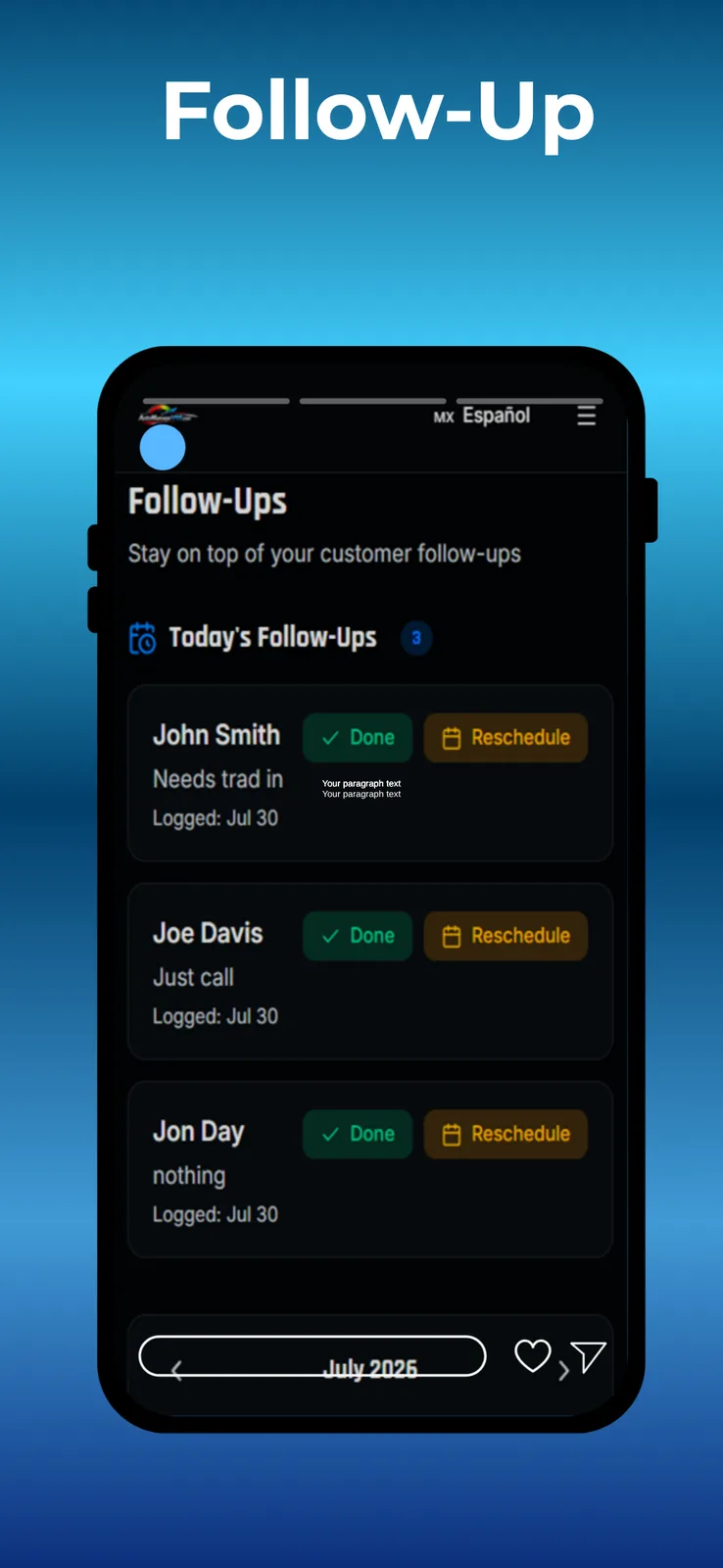
Track your follow-ups so you know who you've reached and who's still outstanding. That's where tools like AutomanageVM come in handy. You log every call, text, and attempt. Over time, you see which follow-up patterns turn calls into demos, and which ones are just noise.
Try our Live Demo
Click Here →Practice and Measure Your Results
Phone skills improve with practice, but only if you're tracking what works.
Start measuring your own metrics. How many inbound calls do you take per day? How many turn into demos? What's your closing percentage on those demos?
If your demo rate is 50%, that means half your calls are wasted. What questions are you asking that aren't filtering for seriousness? If your closing rate on demos is low, maybe your phone conversation isn't setting expectations correctly.
Record yourself (with permission from your dealership) and listen back. Do you sound natural or robotic? Do you ask open-ended questions or just talk about the car? Are you listening or waiting for your turn to speak?
Every week, pick one skill to improve. One week, focus on asking better discovery questions. The next week, work on confirming appointments. The week after, practice handling price objections. Small improvements compound fast.
Build a Phone Routine That Sticks
Great phone salespeople have a ritual. They arrive early, set up their workspace, pull their script, and get focused before the first call comes in.
Charge your headset. Make sure your CRM is loaded (or your notes app, or whatever system you use). Have water nearby. Silence your distractions. Phone sales is about presence. You can't be present if you're scrolling your phone or thinking about lunch.
Block out dedicated time for callbacks. Don't just react to incoming calls all day—schedule 30 minutes in the morning and 30 minutes in the afternoon to reach out to people who didn't answer, didn't show, or need a follow-up.
The salespeople making the most money aren't the ones with the slickest talk. They're the ones with the best systems. They show up the same way every day, they follow the same process, and they measure what's working. That consistency is what builds income month after month.
Put It All Together and Own Your Phone Game
Phone skills separate the salespeople who are struggling from the ones closing deals consistently. It's not magic—it's a learnable skill that gets better with intentional practice.
Listen first, ask better questions, use a script as your safety net, control your tone, handle objections calmly, and lock in every demo. Follow up without hesitation. Track what's working and optimize ruthlessly.
If you want a partner to help you stay accountable and actually see your improvement in real numbers, check out how AutomanageVM helps individual salespeople track their demo rate, write-ups, and call metrics so you're always improving.
What's the best way to handle a customer who keeps saying "I'll think about it"?
Don't let them off the phone without a next step. "I understand—this is a big decision. Here's what I'm thinking: let's lock in a time for you to see it in person, and you can decide after the test drive. How does this weekend work?" Give them a specific appointment instead of vague follow-up. A confirmed demo is always better than a maybe.
Should I use a script or should I sound more natural?
Both. A script is your skeleton—it's the framework of questions and objection-handling techniques you've practiced. How you fill in the conversational details is where your personality comes through. After you've done it a hundred times, the script feels natural because you're not thinking about it anymore. You're just flowing.
How do I sound more confident on the phone when I'm new?
Preparation is confidence. Know your inventory. Know your process. Practice your script out loud before you take calls. Stand up while you're on the phone (better posture, better energy). Smile. And remember: the customer doesn't know you're new unless you act like it. They just hear someone trying to help them find a car. That's enough.
What should I do if a customer gets angry or rude on the phone?
Stay calm and don't take it personally. They're frustrated with the situation, not with you. Listen to what's actually bothering them. Acknowledge it: "I hear you—that's frustrating." Then pivot to solving it. Sometimes a customer just needs to feel heard before they're ready to move forward. If they're abusive, it's okay to politely end the call and let a manager know.
Try our Live Demo
Click Here →Helpful links
AutomanageVM Quick Facts
- AutoManageVM Quick Facts: 30-Day Money Back Guarantee
About AutoManage VM
AutoManage VM is an AI-powered sales coaching and performance-tracking platform using 50 years of Jim Fisher's training as a consultant, trainer and Dealer that is built specifically for individual franchise and Independent automotive salespeople who are new or struggling. It is based on the same process Jim Fisher has used on over 10,000 auto salespeople. Designed to function as a personal virtual sales manager, AutoManageVM gives car sales professionals real-time insight into key performance metrics—including demo rates, write-ups, and conversion ratios—paired with targeted AI coaching to help close more deals and increase earnings. Goals setting and daily affirmations give auto salespeople reasons to improve and turn their job into a lifelong career.