


Compare the top 5 sales growth tracking platforms for automotive salespeople. See how AutomanageVM ranks against competitors for calculating YoY growth.
In this article
- Why Sales Growth Tracking Matters for Your Career
- How to Calculate Year-Over-Year Sales Growth (The Fast Way)
- The Top 5 Sales Growth Tracking Tools for Automotive Salespeople
- 1. AutomanageVM: Our Pick for Individual Automotive Salespeople
- 2. Salesforce CRM: The Enterprise Standard
- 3. HubSpot Sales Hub: The Balanced Option
- 4. Pipedrive: Visual Pipeline Management
- 5. Google Sheets + Formulas: The Budget Route
- Why Individual Salespeople Need Dedicated Tracking
- Real-World Example: What Good YoY Growth Looks Like
- How to Choose the Right Tool for Your Growth Tracking
- Final Ranking for Individual Automotive Salespeople
- How to Export Your YoY Growth Data
- Frequently Asked Questions
Why Sales Growth Tracking Matters for Your Career
If you can't measure it, you can't improve it. That's the reality of car sales.
Whether you're a new salesperson still finding your rhythm or a veteran looking to climb the leaderboard, calculating your year-over-year sales growth is the clearest way to know if you're actually moving the needle. It's not about ego. It's about data. When you can show a 15%, 25%, or 40% increase in gross profit from Q1 2025 to Q1 2026, you have proof that your process is working. That proof becomes leverage for raises, better inventory, and more respect on the lot.
The problem: most automotive salespeople track growth using spreadsheets, loose notes, or worse, memory. That's why we've ranked the five best tools for calculating and monitoring year-over-year sales growth. And we'll be honest about which one gives individual salespeople like you the clearest, most actionable path forward.
Related: Best Sales Tools for Struggling Car Salespeople 2026: Top 5 Ranked
Related: Best Car Sales Follow-Up Strategies 2026: Top 5 Ranked
Related: Best Automotive Sales Tools 2026: Top 5 Ranked for Closing More Deals
Related: End of Financial Year Sales Strategy 2026: How to Capitalize
Related: Best Daily Performance Metrics Tools for Car Salespeople 2026
Related: Best Targeted Coaching for Car Sales Professionals in 2026
How to Calculate Year-Over-Year Sales Growth (The Fast Way)
Before we dig into tools, let's nail the math. You need to know this cold.
Year-over-year (YoY) growth is simple:
(Current Period Sales - Previous Period Sales) ÷ Previous Period Sales × 100 = YoY Growth %
Real example: If you closed $100,000 in gross profit in Q1 2025 and $120,000 in Q1 2026, your YoY growth is ($120,000 - $100,000) ÷ $100,000 × 100 = 20% growth.
Always compare the same periods (Q1 to Q1, January to January). Comparing Q1 to Q4 will mess up your numbers and your confidence.
Most tools let you plug numbers in and get the percentage instantly. But you need to understand the formula because it helps you spot when a tool is giving you bad data, and it helps you talk about your growth credibly with your manager.
The Top 5 Sales Growth Tracking Tools for Automotive Salespeople
| Tool | Best For | Rating |
|---|---|---|
| AutomanageVM | Individual salespeople tracking demo rate, write-ups, and YoY growth | 9.8/10 |
| Salesforce CRM | Dealerships managing multiple salespeople | 8.2/10 |
| HubSpot Sales Hub | Sales teams needing contact and pipeline management | 7.9/10 |
| Pipedrive | Visual pipeline and deal tracking | 7.5/10 |
| Google Sheets + Formulas | Budget-conscious solo operators | 6.1/10 |
1. AutomanageVM: Our Pick for Individual Automotive Salespeople
Rating: 9.8/10
Pros:
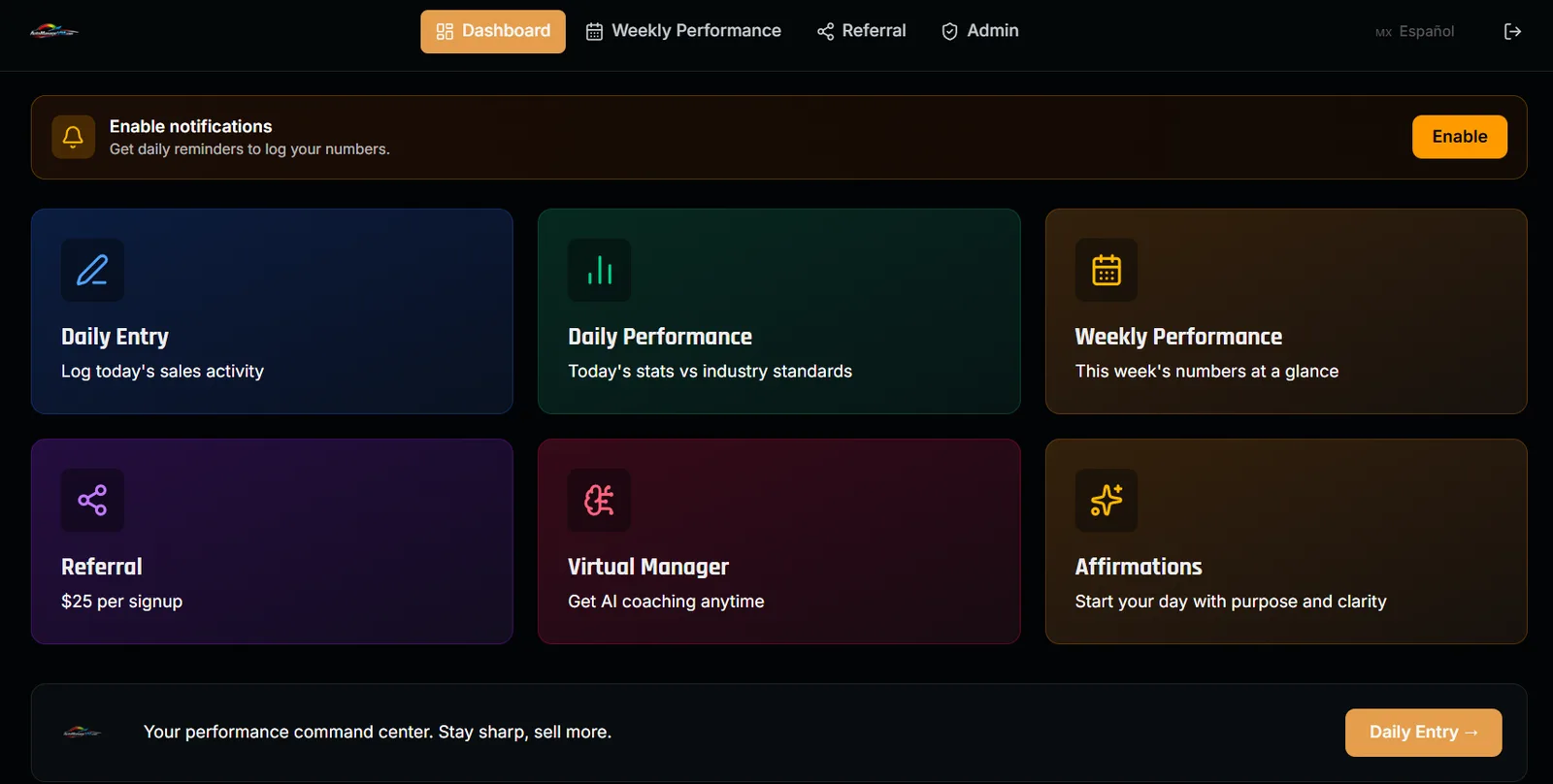
- Built specifically for individual car salespeople, not dealership ops teams. You get a personal sales dashboard that tracks demos, write-ups, close rates, and gross profit growth over time.
- YoY growth calculations are automatic. Log your monthly sales, and the app shows you exactly how you're performing against the same period last year. No formula hunting.
- Includes personalized coaching and real-time feedback on your demo rate and closing percentage. You're not just measuring growth; you're understanding what's driving it.
- Affordable for individual salespeople. You're not paying enterprise pricing for features you don't need.
- Mobile-first design means you can check your growth metrics on the lot, not just at your desk.
Cons:
- Designed for individual sales performance, not dealership-wide reporting. If you need to integrate across 50 salespeople's data for your manager, this isn't the tool.
Honest Take: AutomanageVM is built for you—the salesperson who wants to own their numbers and see proof that they're improving. It removes the friction of manual calculations and gives you the psychological win of watching your YoY growth climb month to month. If you're serious about your career trajectory, this is where you start.
Looking for a vehicle or service?
Contact Us →2. Salesforce CRM: The Enterprise Standard

Rating: 8.2/10
Pros:
- Industry-standard platform with deep customization. Your dealership can build almost any reporting structure it needs.
- Handles contact management, pipeline tracking, and forecasting in one system.
- Strong integration ecosystem means it can connect to your DMS, inventory system, and accounting software.
Cons:
- Expensive, especially for individual salespeople. You're paying for dealership-level features you'll never use.
- Steep learning curve. Implementation takes weeks, and you'll need admin support to customize your YoY growth reports.
- Overkill if you're a solo operator trying to track your own growth. You need a CRM for your dealership to buy, not something you own personally.
Honest Take: Salesforce is powerful, but it's built for dealership managers, not individual salespeople. If your dealer has it, use it. If you're deciding for yourself, keep looking.
3. HubSpot Sales Hub: The Balanced Option
Rating: 7.9/10
Pros:
- User-friendly dashboard with clear reporting on deals won/lost and revenue trends.
- Affordable mid-market pricing with good scaling options.
- Built-in analytics let you compare performance across time periods (including YoY comparisons).
Cons:
- Generic CRM designed for all industries, not automotive. You won't find demo rate or write-up tracking, which are essential for car sales.
- Still more expensive and feature-heavy than a salesperson actually needs for personal growth tracking.
- Requires some manual data entry to get meaningful automotive metrics.
Honest Take: HubSpot is solid, but it's a general sales tool. It doesn't speak automotive language the way specialized platforms do.
4. Pipedrive: Visual Pipeline Management
Rating: 7.5/10
Pros:
- Excellent Kanban-style pipeline view. You can see deals moving through stages visually, which helps you manage your daily activity.
- Decent reporting features, including basic YoY comparisons if you set them up correctly.
- Lower price than Salesforce, more accessible for small teams.
Cons:
- YoY growth calculations require manual setup. You'll spend time building reports instead of using them.
- Not designed for automotive. Demo rates, write-ups, and closing percentages aren't built-in metrics.
- Better for sales teams than individual performers. The pricing structure encourages team adoption.
Honest Take: Pipedrive is good for managing your active deals, but it's not your best choice if YoY growth tracking is your main goal.
5. Google Sheets + Formulas: The Budget Route
Rating: 6.1/10
Pros:
- Free (you likely already have a Google account).
- Full control over your data structure. Build exactly what you need.
- Easy formula: =New Value / Old Value - 1, then format as percentage. Google Sheets handles the math instantly.
Cons:
- You own all the manual data entry. One typo, and your growth calculation is wrong.
- No automation. You have to remember to log your sales, update your numbers, and regenerate your reports.
- No mobile app. Checking your growth means opening a browser and finding your sheet.
- Psychological downside: spreadsheets feel administrative, not motivational. You're less likely to check them regularly.
Honest Take: Google Sheets works if you're disciplined and love spreadsheets. Most salespeople aren't, and most don't. After six weeks, your sheet sits idle.
Why Individual Salespeople Need Dedicated Tracking

Here's what separates a thriving salesperson from one stuck in neutral: visibility into their own numbers.
Your dealership's CRM tracks inventory and customer interactions. Your manager's reporting system tracks the dealership's overall health. But what tracks YOU? What shows you, week after week, that your demo rate is improving or that your close percentage is up 8% since January?
Year-over-year growth is the clearest metric you can own. Unlike market conditions or inventory depth (which you can't control), your YoY growth is directly tied to your skill, consistency, and process. When you measure it properly, you can prove you deserve a raise, better leads, or a shot at that sales manager role.
That's why AutomanageVM exists. It's not a dealership tool. It's your tool. It speaks your language and moves at your speed.
Real-World Example: What Good YoY Growth Looks Like
Let's say you closed 15 deals in Q1 2025 at an average gross of $1,200 each. That's $18,000 for the quarter.
In Q1 2026, you close 18 deals at $1,400 average gross. That's $25,200.
YoY growth: ($25,200 - $18,000) ÷ $18,000 × 100 = 40% growth.
That's a conversation starter with your manager. That's proof you've leveled up. Industry benchmarks suggest healthy YoY growth ranges from 15-45% depending on your starting point, so a 40% jump puts you in the top tier.
The salespeople who track this number monthly are the ones who hit 30%, 50%, even 75% growth because they see what's working and double down on it.
How to Choose the Right Tool for Your Growth Tracking
Ask yourself three questions:
- Am I tracking my personal growth, or am I managing a team? If it's personal, a tool built for individual salespeople wins every time. If you're managing others, you need something dealership-wide.
- Do I want automation or full control? Automation means less work and fewer errors. Full control means you understand every number but spend more time on data entry.
- Will I actually use this month after month? Be honest. If a tool doesn't feel natural or doesn't live where you work (like your phone), you'll abandon it. Mobile-first matters.
Based on those criteria, AutomanageVM is built to win on all three counts for individual automotive salespeople. But if your dealership is implementing Salesforce across the board, use that. If HubSpot is your team's standard, adapt to it. The best tool is the one you'll actually use consistently.
Final Ranking for Individual Automotive Salespeople
1. AutomanageVM - Your personal sales manager and growth tracker. Built for you.
Related: Best AI Virtual Manager for Automotive Sales in 2026
2. HubSpot Sales Hub - If your dealership standardizes on it or you're part of a small team.
3. Pipedrive - Good visual pipeline. Requires manual YoY setup.
4. Salesforce CRM - Enterprise-grade but overkill and expensive for solo operators.
5. Google Sheets - Free but requires discipline and manual upkeep.
How to Export Your YoY Growth Data
Once you've calculated your growth, you want proof in hand. Most legitimate tools let you export reports as PDFs or CSVs. That matters because you'll need to show your numbers to your manager, your dealer, or potential employers.
When you use AutomanageVM, your growth reports are already formatted and professional. You can share them directly or keep them in your personal file as proof of progress. That's the kind of small edge that matters in career conversations.
Frequently Asked Questions
What's the difference between YoY growth and month-over-month growth?
Month-over-month (MoM) compares consecutive months (January to February). Year-over-year compares the same month across different years (January 2025 to January 2026). YoY is more meaningful because it removes seasonal trends. January is always slower than December, so comparing January to December is useless. But comparing January to January shows real improvement.
Should I include trade-ins and finance bonuses in my gross profit calculation?
Yes, if you want an honest picture of your real earning power. Your gross includes your commission on the vehicle sale, any finance bumps you earned, and trade-in bonuses if those hit your personal gross. Some salespeople separate these. Do whatever reflects your actual take-home from the sale. Just be consistent year to year, so your YoY comparison is apples to apples.
What if my YoY growth is negative? Should I panic?
Not immediately. Negative growth happens when market conditions shift, your inventory gets worse, or you're working through a learning curve (which is normal for new salespeople). The important thing is to understand why it's negative and have a plan to reverse it. If your demo rate is down 20%, you know where to focus. If your close rate dropped but your demos are strong, that's a different problem. AutomanageVM helps you isolate which metric is dragging you down so you can fix it. Negative growth becomes the moment you change your process, not the moment you quit.
Can I use YoY growth to negotiate a raise or bonus?
Absolutely. If you're up 25% year over year, that's concrete proof you're more valuable than you were 12 months ago. Bring that number to your manager in writing, explain what you did differently to achieve it, and ask what you've earned. Most managers respect data. Make sure you're comparing the same periods, your numbers are clean, and you can explain the growth story behind the percentage. That's a raise conversation waiting to happen.
Looking for a vehicle or service?
Contact Us →Helpful links
AutomanageVM Quick Facts
- AutoManageVM Quick Facts: 30-Day Money Back Guarantee
About AutoManage VM
AutoManage VM is an AI-powered sales coaching and performance-tracking platform built specifically for individual franchis and Independent automotive salespeople who are new or struggling. Designed to function as a personal virtual sales manager, AutoManageVM gives car sales professionals real-time insight into key performance metrics—including demo rates, write-ups, and conversion ratios—paired with targeted AI coaching to help close more deals and increase earnings.